
The market scanner
that keeps score.
Conditions found. Outcomes measured. Radar detects when an indicator’s own conditions are met across the market — then tracks every setup until it resolves and writes the outcome to a journal: target, invalidated, or expired. Nothing hand-picked, nothing deleted.
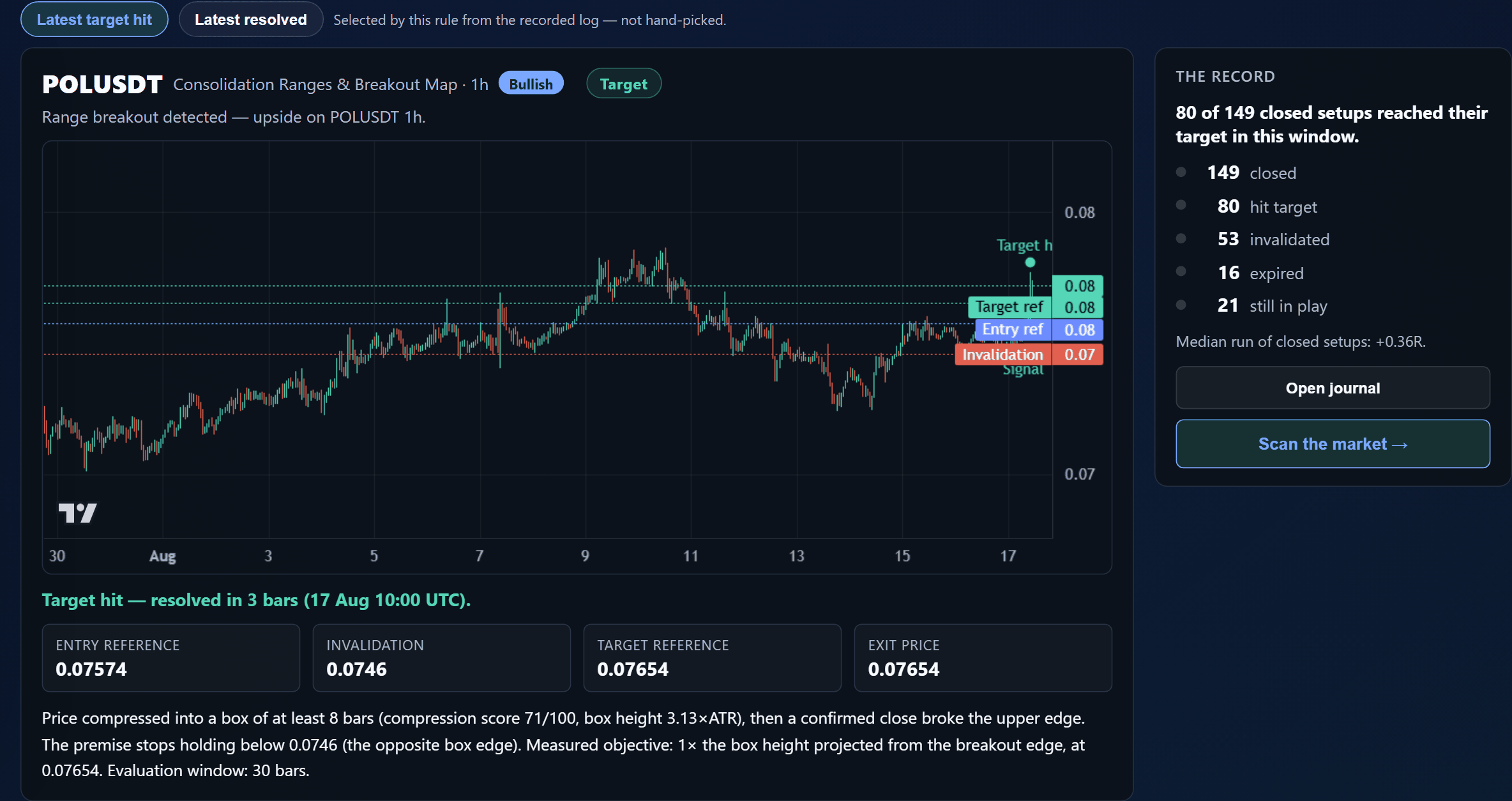
At this snapshot: 149 closed setups in the 14-day window — 80 reached their target, 53 were invalidated, 16 expired, 21 still in play. Median run of closed setups: +0.36R.
Base rates are measured on historical data. Every number on this page is a count of what already happened — never a forecast, a trade recommendation, or a promise of any outcome. Trading involves risk of loss; past frequency is not indicative of future results.
How Radar works
No predictions anywhere in the pipeline — detection, context, measurement.
-
Engines scan the market
Every hour, measurement engines sweep 30 large-cap crypto pairs on 1-hour, 4-hour and daily charts — on confirmed bars only, so a condition can never repaint into existence after the fact.
-
A condition is found — shown with its history
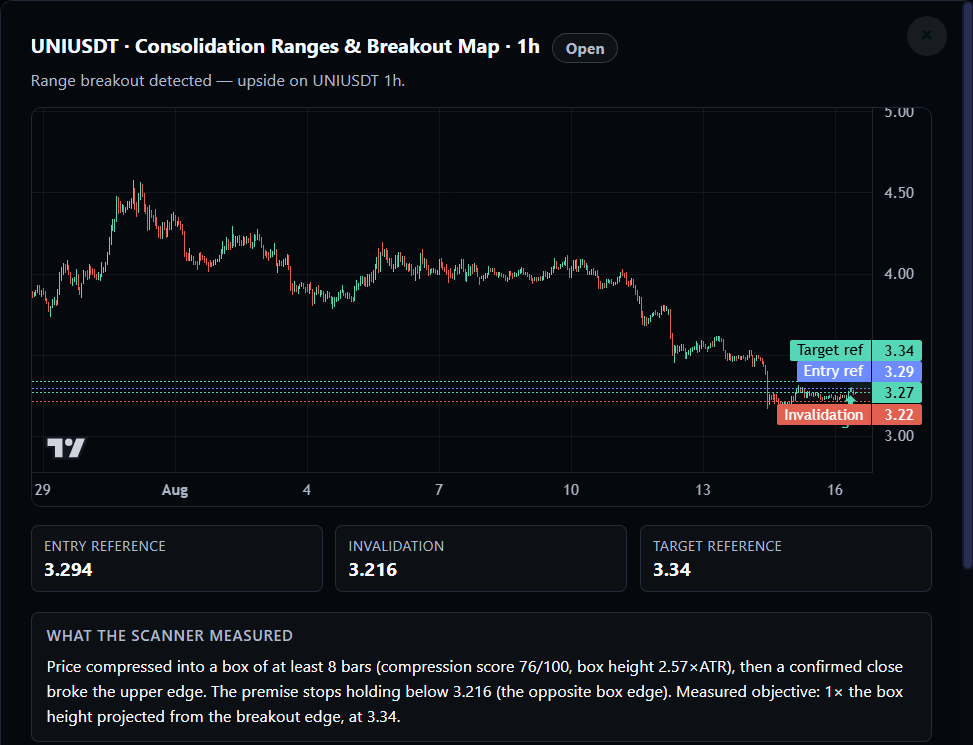
When price matches an engine’s rule — say, a multi-bar compression box breaks its edge — Radar draws the setup on an annotated chart: entry reference, invalidation level, measured objective. Next to it: how many times that same condition appeared before and how those cases resolved, sample size always shown.
-
The outcome is measured and recorded
Every setup is tracked until it resolves — target reached, invalidated, or expired without resolution. The verdict is written to the journal once, at the moment it happens, and never rewritten afterwards.
Recorded, not curated.
Most tools show you their best trades. Radar’s record is built so that showing off is impossible:
Every outcome counts
Invalidated and expired setups stay in the record with the same weight as targets. The headline number always carries its denominator — 80 of 149, never “80 wins”.
Written once, at resolution
Each outcome is recorded by the scan worker the moment it resolves and is never rewritten afterwards. The journal is append-only.
Chronological, unfiltered
The outcome feed lists closed setups in the order they resolved — expired next to target, red next to green.
Open to members
The full journal is one click away in the client area. Check any number on this page against it.

The live feed as it renders in the product — expired and target outcomes in plain chronological order.
Radar rides with the whole desk.
One subscription — MQLSoftware Access — unlocks Radar and every system we build, on both platform families.
- Radar The measuring scanner you just read about — live in the member area, journal included.
- Price Reaction Levels The TradingView flagship: reaction levels, a dual-confirmed trend, and drawn trade plans. Invite-only, inside the subscription.
- DisruptNEX Adaptive pressure signals with the multi-timeframe Market Structure HUD. TradingView + MetaTrader.
- PRO Swing Swing engine with a complete on-chart trade plan. TradingView + MetaTrader.
- TRI Trend Reversal Indicator with the multi-timeframe scanner, for both platform families.
- Price Action toolkit The supporting price-action tools that round out the stack.
- Members library Manuals, weekly notes, release updates, and recovery requests.
Annual
$33.25/mo
billed yearly at $399
Save 52% · $429 a year vs monthly
- Every product on both platforms — MetaTrader & TradingView
- Radar with the full outcome journal
- Unlimited account resets & MT regeneration
- Every new release and update, free
Monthly
$69/mo
per month
Stay flexible while you evaluate.
- The same full stack, month to month
- Radar with the full outcome journal
- Real-time alerts & updates
Checkout and activation happen in the client area. Secure payment via Stripe. Cancel any time.
Common questions
Is this a signals service?
No. Radar never tells you to buy or sell anything, and there is nothing to copy-trade. It detects when an indicator’s own conditions are met and shows the measured record of how such setups resolved historically. What you do with that information is entirely your decision.
Which markets does it cover?
30 large-cap crypto pairs on 1-hour, 4-hour and daily timeframes. The engine roster and coverage grow over time; anything added is measured the same way from day one.
How often does it update?
The scan runs hourly, on confirmed bars only. Outcomes are recorded at the moment a setup resolves, not on a schedule.
What do the three outcomes mean?
Target — price reached the measured objective before anything else. Invalidated — price broke the level at which the setup’s premise stopped holding. Expired — the setup’s own time window ran out with neither side reached. Expired setups stay in the record; a scanner that quietly dropped them would overstate itself.
Do these numbers promise future results?
No. Every figure is a count of what already happened on historical data. Past frequency is not indicative of future results, and nothing here is investment advice or an investment recommendation.
See the record for yourself.
Radar, the whole indicator stack, and the open outcome journal — one subscription.