
System 02 · Intraday structure
See pressure in the context that produced it.
DisruptNEX is a structured analytical overlay: market regime, exhaustion, impulse activity and a multi-timeframe HUD share one internal reference instead of behaving like unrelated indicators.
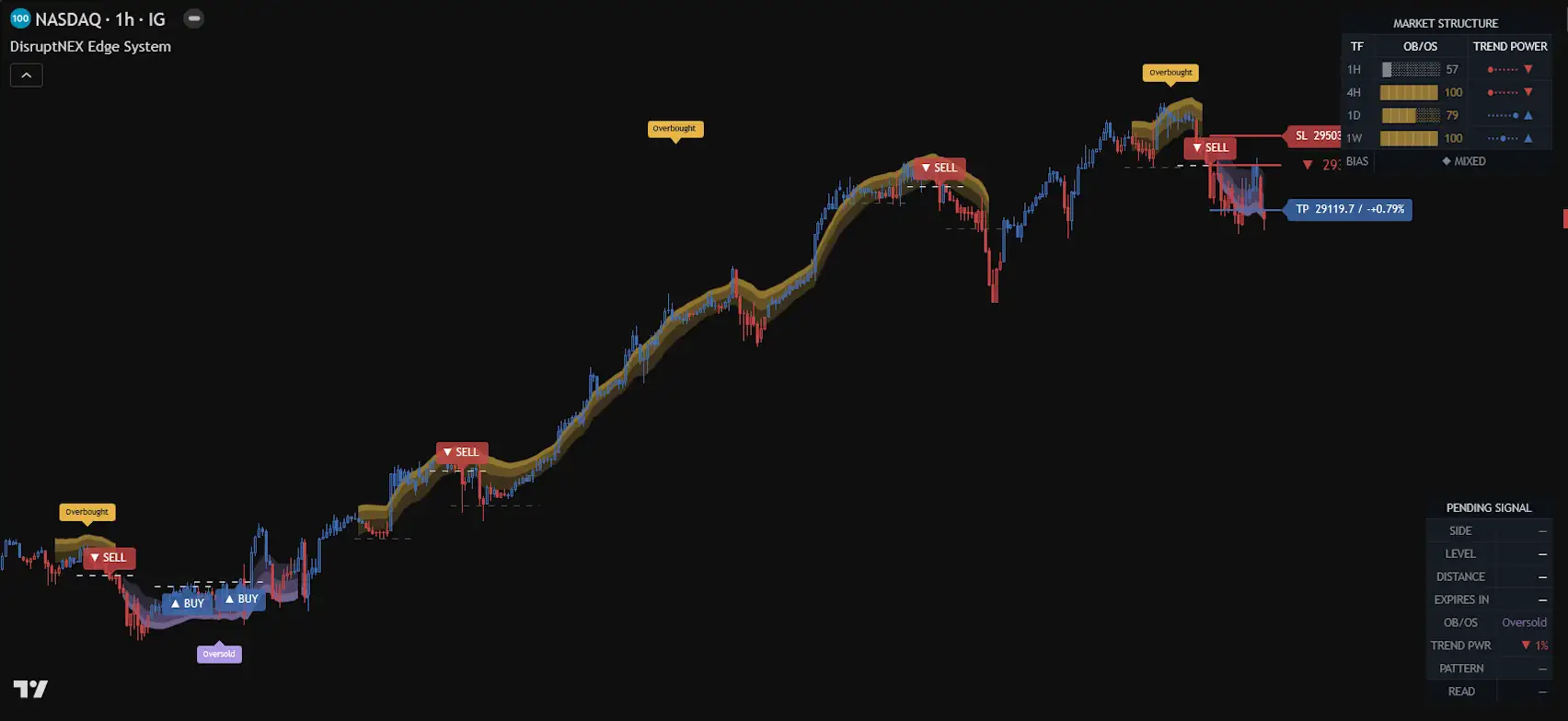
What the product actually does
Read the mechanism.
Then judge the fit.
Regime comes first.
Candle state is anchored to the system’s shared baseline, giving every later layer the same directional context. The purpose is not to add more marks—it is to keep each mark interpretable.
- Directional candle state
- Shared internal reference
- Context before entry
- Discretion stays with the trader
Extension and renewed pressure are different events.
Exhaustion ribbons describe persistence away from the reference. Spark impulses describe renewed directional displacement. Keeping them separate helps distinguish an extended move from activity resuming after hesitation.
- Adaptive exhaustion thresholds
- Impulse activity after consolidation or pullback
- Optional pattern context
- Dynamic structural references
The HUD compresses the higher-timeframe read.
Trend direction, maturity and exhaustion are summarised across timeframes so the chart can be read without repeatedly changing tabs. The product supports discretionary decisions; it does not execute trades.
- Trend direction
- Trend maturity
- Overbought / oversold state
- Confirmed event alerts
A disciplined first pass
Three steps.
No theatre.
- Orient
Read the candle regime and the multi-timeframe HUD first.
- Differentiate
Separate exhaustion from a fresh impulse inside the active regime.
- Frame
Use the current structural references and plan layer before deciding whether to act.
Claim boundary
What we can prove—and what we do not imply.
Current TradingView release notes state that signal-producing paths wait for full bar closure and multi-timeframe queries use strict no-lookahead handling. Platform interfaces can differ; this page does not claim byte-for-byte parity across editions.
TradingView + MetaTrader · Client Area · Updates & support